
The Dadri-Noida-Ghaziabad Investment Region (DNGIR), popularly known as New Noida, is being planned as a large-scale industrial, logistics, residential and economic development region in western Uttar Pradesh. The region covers parts of Bulandshahr and Gautam Buddha Nagar and is connected with the broader Delhi–Mumbai Industrial Corridor (DMIC) framework. The Government of India has previously identified the Dadri-Noida-Ghaziabad Investment Region as one of the DMIC investment regions.
The expansion of Noida toward the Bulandshahr side took a major step in January 2021, when the Uttar Pradesh government notified 80 villages—60 in Bulandshahr and 20 in Gautam Buddha Nagar—for inclusion under the Noida Authority’s ambit, with the area intended to be developed as a special investment region.
However, the later DNGIR Master Plan 2041 uses a broader final planning framework. Current published summaries of the 2024-notified plan describe the region as covering 84 villages and about 209 sq. km., so readers should distinguish the earlier 80-village notification from the later DNGIR planning boundary.
What Is a Special Investment Region In New Noida?
A Special Investment Region is essentially a designated area planned for large-scale, integrated economic and industrial development.
Instead of development taking place through scattered individual projects, the objective is to create a coordinated ecosystem containing infrastructure such as:
- Industrial areas
- Manufacturing units
- Logistics and warehousing
- Agro and food-processing facilities
- IT and technology-related activities
- Commercial areas
- Residential development
- Institutional and knowledge facilities
- Roads and transport infrastructure
- Other supporting urban facilities
The Dadri-Noida-Ghaziabad region has also been associated with sectors such as general manufacturing, automobiles and auto components, IT/ITES, high-tech industries, agro and food processing and R&D.
Villages in Bulandshahr District In New Noida
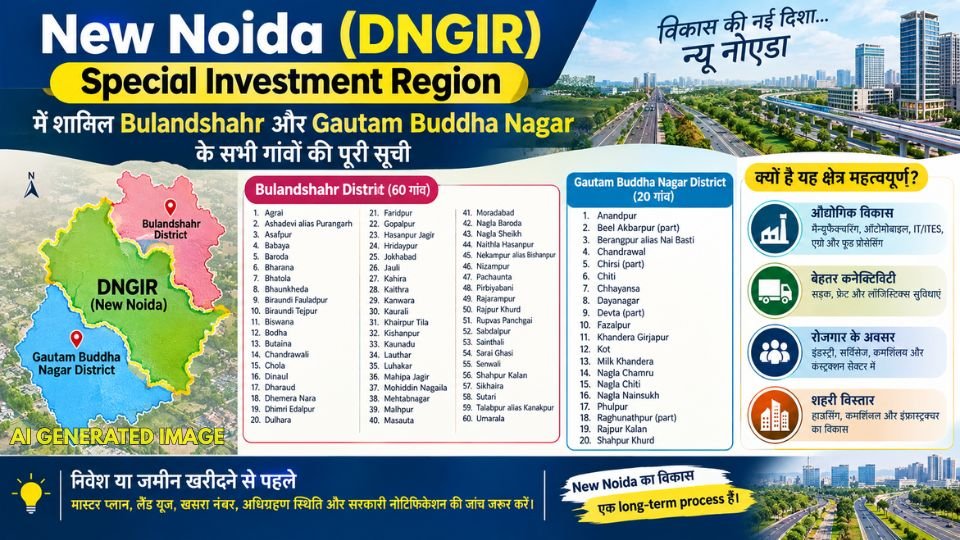
The earlier Special Investment Region notification identified 60 villages in Bulandshahr district. The village names are listed below, with spellings standardized where possible because different public sources sometimes use slightly different English transliterations.
Village List
- Agrai
- Ashadevi alias Purangarh
- Asafpur
- Babaya
- Baroda
- Bharana
- Bhatola
- Bhaunkheda
- Biraundi Fauladpur
- Biraundi Tejpur
- Biswana
- Bodha
- Butaina
- Chandrawali
- Chola
- Dinaul
- Dharaud
- Dhemra Nara
- Dhimri Edalpur
- Dulhara
- Faridpur
- Gopalpur
- Hasanpur Jagir
- Hridaypur
- Jokhabad
- Jauli
- Kahira
- Kaithra
- Kanwara
- Kaurali
- Khairpur Tila
- Kishanpur
- Kaunadu
- Lauthar
- Luhakar
- Mahipa Jagir
- Mohiddin Nagaila
- Mehtabnagar
- Malhpur
- Masauta
- Moradabad
- Nagla Baroda
- Nagla Sheikh
- Naithla Hasanpur
- Nekampur alias Bishanpur
- Nizampur
- Pachaunta
- Pirbiyabani
- Rajarampur
- Rajpur Khurd
- Rupvas Panchgai
- Sabdalpur
- Sainthali
- Sarai Ghasi
- Senwali
- Shahpur Kalan
- Sikhaira
- Sutari
- Talabpur alias Kanakpur
- Umarala
Contemporary village lists corroborate the 60-village Bulandshahr component, although spellings such as Bhaunkheda/Bhokheda, Bodha/Boda, Dinaul/Dinola and Sikhaira/Shikhera vary between sources.
Villages in Gautam Buddha Nagar District In New Noida
The original notification included 20 villages/partial villages from Gautam Buddha Nagar.
Villages List
- Anandpur
- Beel Akbarpur — Part
- Berangpur alias Nai Basti
- Chandrawal
- Chirsi — Part
- Chiti
- Chhayansa
- Dayanagar
- Devta — Part
- Fazalpur
- Khandera Girjapur
- Kot
- Milk Khandera
- Nagla Chamru
- Nagla Chiti
- Nagla Nainsukh
- Phulpur
- Raghunathpur — Part
- Rajpur Kalan
- Shahpur Khurd
This 20-village list is also reflected in publicly available compilations of the 2021 notification.
READ ALSO – New Noida Master Plan 2041 – See 37 Village List Phase 1 | Complete Guide
Why Are These Villages Important?
The importance of these villages goes beyond their inclusion in an administrative list.
The region was identified as an investment area with the objective of creating a large economic and industrial growth zone around the Noida–Dadri–Bulandshahr belt.
The strategic importance comes from several factors:
- Industrial Development
One of the central objectives is to create land and infrastructure for industries and manufacturing. The wider DMIC framework identifies sectors including manufacturing, automobiles, IT/ITES, high-tech industries, agro-processing and food processing.
- Logistics & Connectivity
The location of DNGIR is significant because it sits within the broader NCR and DMIC ecosystem. Improved road, freight and logistics connectivity is intended to support industrial activity and movement of goods.
- Employment Generation
The development model is intended to generate employment not only through factories but also through logistics, services, commercial activity, construction and supporting businesses.
The Government of India had estimated substantial long-term direct and indirect employment potential for the DMIC investment regions, including the Dadri-Noida-Ghaziabad Investment Region.
- Urban Expansion
As infrastructure and employment centres develop, surrounding areas can experience changes in land use, housing demand, commercial activity and transportation requirements.
This is one reason the villages included in the planning boundary are closely watched by both landowners and investors.
From Special Investment Region to New Noida
The idea of a Dadri-Noida-Ghaziabad Investment Region predates the current New Noida project. It was already identified within the DMIC framework years ago. The Government of India listed DNGIR as a 200 sq. km investment region under Phase-I of DMIC in its 2018 update.
Later, the Uttar Pradesh government notified 80 villages in January 2021 for expansion of the Noida Authority’s jurisdiction and development as a special investment region.
The subsequent DNGIR Master Plan 2041 provided a more comprehensive long-term planning framework. Current summaries describe the final planning area as approximately 209 sq. km, with development planned in multiple phases extending toward 2041.
Therefore, when discussing the villages today, it is important not to automatically treat the 2021 80-village notification and the final DNGIR Master Plan boundary as exactly the same thing.
What Does It Mean for Investors?
For investors, the presence of a Special Investment Region can indicate a long-term infrastructure and economic-development story, but it should not be treated as a guarantee of appreciation.
Before purchasing land around the DNGIR/New Noida region, investors should verify the official planning documents and land records rather than relying only on broker claims or village names circulating on social media.
Important checks include:
- Land Verification
- Master Plan
- Road Alignment
- Acquisition Status
- Abadi Status
- Authority Records
Therefore, anyone checking a particular property should verify the latest official notification/master-plan map and the specific khasra number, rather than relying solely on a general village list.
Conclusion
The villages falling under DNGIR—or New Noida—offer potential for industrial, logistics, commercial, and infrastructure development in the coming years. However, before buying or selling any land, it is essential to verify details such as the Master Plan, land use, Khasra number, acquisition status, and official notifications.
The development of New Noida is a long-term process; therefore, it is crucial to make property-related decisions based on accurate information and verified documents.